2021年6月英语六级真题(第2套)
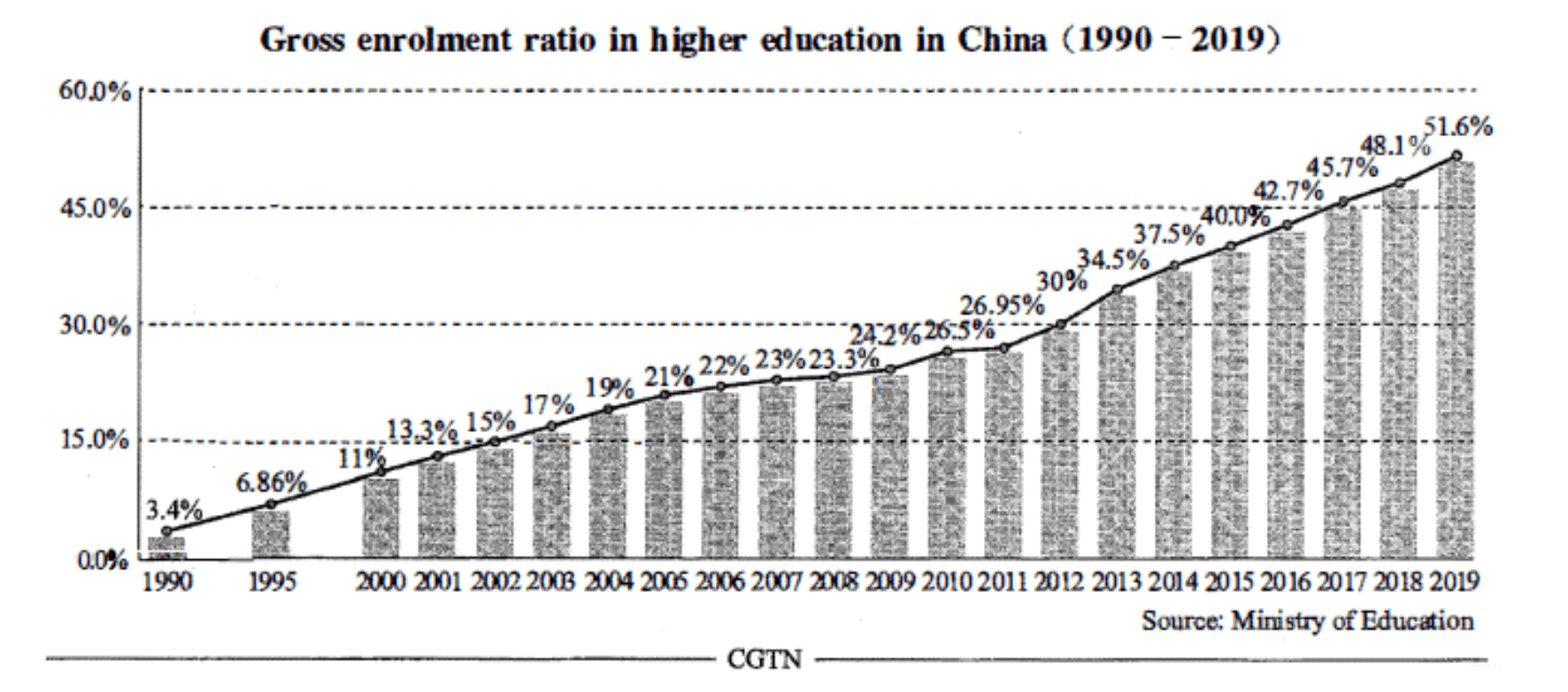
Directions: For this part, you are allowed 30 minutes to write an essay based on the chart below. You should start your essay with a brief description of the chart and comment on China's achievements in higher education. You should write at least 150 words but no more than 200 words.
Section A
Section B
Section C
Section A
Directions: In this section, there is a passage with ten blanks. You are required to select one word for each blank from a list of choices given in a word bank following the passage. Read the passage through carefully before making your choices. Each choice in the bank is identified by a letter. Please mark the corresponding letter for each item on Answer Sheet 2 with a single line through the centre. You may not use any of the words in the bank more than once.
I'm always baffled when I walk into a pharmacy and see shelves bursting with various vitamins, extracts and other supplements, all promising to accelerate or promote weight loss. Aisles of marketing genius belie (掩饰) the fact that, , weight loss is dictated by the laws of arithmetic. Economist Jessica Irvine wrote a book about how she used math to help her lose more than 18 kilograms. If calories taken in are less than calories , weight shall be lost, and so it is with money.
Despite the of financial products, services and solutions geared towards accumulating wealth, if all begins with the same : getting ahead financially requires a reduction of spending, so that income is greater than expenses. I was reminded of this again recently listening to an interview with Nicole Haddow, the author of Smashed Avocado, explaining how she cracked the property market at 31. It was quite a , given where she had been two years earlier.
Nicole didn't celebrate her 30th birthday as she had . She was sobbing at the dinner table with her parents, with whom she had just moved back in. She had no stable income, $12,000 in credit-card debt and no plan, but to her , her father, an accountant, told her that her financial wasn't as bad as she thought. He said, on her income, with some changes, she would be able to buy an investment unit within two years, which she did.
Nicole admitted she was fortunate, as she was able to live with her parents and her spending and life-to get herself on track financially. Creating a gap between her income and spending required a paradigm shift and sacrifice and commitment, but by going into financial lockdown, Nicole gained financial independence.
Section B
Directions: In this section. you are going to read a passage with ten statements attached to it. Each statement contains information given in one of the paragraphs. Identify the paragraph from which the information is derived. You may choose a paragraph more than once. Each paragraph is marked with a letter. Answer the questions by marking the corresponding letter on Answer Sheet 2.
France's beloved cathedral only minutes away from complete destruction
Section C
Directions: There are 2 passages in this section. Each passage is followed by some questions or unfinished statements. For each of them there are four choices marked A), B), C), and D). You should decide on the best choice and mark the corresponding letter on Answer Sheet 2 with a single line through the centre.
Passage One
We often think of drawing as something that takes inborn talent, but this kind of thinking stems from our misclassification of drawing as, primarily, an art form rather than a tool for learning.
Researchers, teachers, and artists are starting to see how drawing can positively impact a wide variety of skills and disciplines.
Most of us have spent some time drawing before, but at some point, most of us stop drawing. There are people who don't, obviously, and thank god for that: a world without designers and artists would be a very shabby one indeed.
Some argue that so many adults have abandoned drawing because we've miscategorized it and given it a very narrow definition. In his book, Stick Figures: Drawing as a Human Practice, Professor D. B. Dowd argues that we have misfiled the significance of drawing because we see it as a professional skill instead of a personal capacity. We mistakenly think of "good" drawings as those which work as recreations of the real world, as realistic illusions. Rather, drawing should be recategorized as a symbolic tool.
Human beings have been drawing for 73,000 years. It's part of what it means to be human. We don't have the strength of chimpanzees (大猩猩) because we've given up animal strength to manipulate subtle instruments, like hammers, spears, and-later-pens and pencils. The human hand is an extremely dense network of nerve endings. In many ways, human beings are built to draw.
Some researchers argue that doodling (涂画) activates the brain's so-called default circuit-essentially, the areas of the brain responsible for maintaining a baseline level of activity in the absence of other stimuli. Because of this, some believe that doodling during a boring lecture can help students pay attention. In one study, participants were asked to listen to a list of names while either doodling or sitting still. Those who doodled remembered 29 percent more of the names than those who did not.
There's also evidence that drawing talent is based on how accurately someone perceives the world. The human visual system tends to misjudge size, shape, color, and angles but artists perceive these qualities more accurately than non-artists. Cultivating drawing talent can become an essential tool to improve people's observational skills in fields where the visual is important.
Rather than think of drawing as a talent that some creative people are gifted in, we should consider it as a tool for seeing and understanding the world better -- one that just so happens to double as an art form. Both absent-minded doodling and copying from life have been shown to positively affect your memory and visual perception, so complain loudly the next time your school board slashes the art department's budget.
Passage Two
The car has reshaped our cities. It seems to offer autonomy for everyone. There is something almost delightful in the detachment from reality of advertisements showing mass-produced cars marketed as symbols of individuality and of freedom when most of their lives will be spent making short journeys on choked roads.
For all the fuss made about top speeds, cornering ability and acceleration, the most useful gadgets on a modern car are those which work when you're going very slowly: parking sensors, sound systems, and navigation apps which will show a way around upcoming traffic jams. This seems to be one of the few areas where the benefit of sharing personal information comes straight back to the sharer: because these apps know where almost all the users are, and how fast they are moving almost all the time, they can spot traffic congestion (堵塞) very quickly and suggest ways round it.
The problem comes when everyone is using a navigation app which tells them to avoid everyone else using the same gadget. Traffic jams often appear where no one has enough information to avoid them. When a lucky few have access to the knowledge, they will benefit greatly. But when everyone has perfect information, traffic jams simply spread onto the side roads that seem to offer a way round them.
This new congestion teaches us two things. The first is that the promises of technology will never be realised as fully as we hope; they will be limited by their unforeseen and unintended consequences. Sitting in a more comfortable car in a different traffic jam is pleasant but hardly the liberation that once seemed to be promised. The second is that self-organisation will not get us where we want to go. The efforts of millions of drivers to get ahead do not miraculously produce a situation in which everyone does better than before, but one in which almost everyone does rather worse. Central control and collective organisation can produce smoother and fairer outcomes, though even that much is never guaranteed.
Similar limits can be foreseen for the much greater advances promised by self-driving cars. Last week, one operated by the taxi company Uber struck and killed a woman pushing her bicycle across a wide road in Arizona. This was the first recorded death involving a car which was supposed to be fully autonomous. Experts have said that it suggests a "catastrophic failure" of technology.
Increasingly, even Silicon Valley has to acknowledge the costs of the intoxicating (邻人陶醉的) hurry that characterises its culture. What traffic teaches us is that reckless and uncontrolled change is as likely to harm us as it is to benefit us, and that thoughtful regulation is necessary for a better future.
Directions: For this part, you are allowed 30 minutes to translate a passage from Chinese into English. You should write your answer on Answer Sheet 2.
本页为2021年6月英语六级真题(第2套),支持听力、阅读、写作和翻译在线练习。
写作题目:China's achievements in higher education
翻译题干节选:青海是中国西北部的一个省份,平均海拔3000米以上,大部分地区为高山和高原。青海省得名于全国最大的咸水湖青海湖。青海湖被誉为"中国最美的湖泊",是最受欢迎的旅游…