2021年考研英语二真题
Use of English
Directions: Read the following text. Choose the best word(s) for each numbered blank and mark A, B, C or D on the ANSWER SHEET. (10 points)
It is not difficult to set targets for staff. It is much harder, 1____, to understand their negative consequences. Most work-related behaviors have multiple components. 2____ one and the others become distorted.
Travel on a London bus and you will 3____ see how this works with drivers. Watch people get on and show their tickets. Are they carefully inspected? Never. Do people get on without paying? Of course! Are there inspectors to 4____ that people have paid? Possibly, but very few. And people who run for the bus? They are 5____. How about jumping lights? Buses do so almost as frequently as cyclists.
Why? Because the target is 6____. People complained that buses were late and infrequent. 7____, the number of buses and bus lanes were increased, and drivers were 8____ or punished according to the time they took. And drivers hit these targets. But they 9____ hit cyclists. If the target was changed to 10____, you would have more inspectors and more sensitive pricing. If the criterion changed to safety, you would get more 11____ drivers who obeyed traffic laws. But both these criteria would be at the expense of time.
There is another 12____: people became immensely inventive in hitting targets. Have you 13____ that you can leave on a flight an hour late but still arrive on time? Tailwinds? Of course not! Airlines have simply changed the time a 14____ is meant to take. A one-hour flight is now billed as a two-hour flight.
The 15____ of the story is simple. Most jobs are multidimensional, with multiple criteria. Choose one criterion and you may well 16____ others. Everything can be done faster and made cheaper, but there is a 17____. Setting targets can and does have unforeseen negative consequences.
This is not an argument against target-setting. But it is an argument for exploring consequences first. All good targets should have multiple criteria 18____ critical factors such as time, money, quality and customer feedback. The trick is not only to 19____ just one or even two dimensions of the objective, but also to understand how to help people better 20____ the objective.
Part A
Text 1
"Reskilling" is something that sounds like a buzzword but is actually a requirement if we plan to have a future where a lot of would-be workers do not get left behind.We know we are moving into a period where the jobs in demand will change rapidly, as will the requirements of the jobs that remain. Research by the World Economic Forum finds that on average 42 per cent of the"core skills"within job roles will change by 2022.That is a very short timeline. The question of who should pay for reskilling is a thomy one. For individual companies, the temptation is always to let go of workers whose skills are no longer in demand and replace hem with those whose skills are. That does not always happen. AT&T is often given as the gold standard of a company who decided to do a massive reskilling program rather than go with a fire-and-hire strategy. Other companies including Amazon and Disney had also pledged to create their own plans. When the skills mismatch is in the broader economy though, the focus usually turns to government to handle.Efforts in Canada and elsewhere have been arguably languid at best,and have given us a situation where we frequently hear of employers begging for workers,even at times and in regions where unemployment is high. With the pandemic, unemployment is very high indeed. In February, at 3.5 per cent and 5.5 per cent respectively, unemployment rates in Canada and the United States were at generational lows and worker shortages were everywhere. As of May, those rates had spiked up to 13.3 per cent and 13.7 per cent,and although many worker shortages had disappeared,not all had done so.In the medical field, to take an obvious example,the pandemic meant that there were till clear shortages of doctors,nurses and other medical personnel. Of course,it is not like you can take an unemployed waiter and train him to be a doctor in a few weeks,no matter who pays for it.But even if you cannot close that gap, maybe you can close others,and doing so would be to the benefit of all concerned. That seems to be the case in Sweden: When forced to furlough 90 per cent of their cabin staff, Scandinavian Airlines decided to start up a short retraining program that reskilled the laid-off workers to support hospital staf. The effort was a collective one and involved other companies as well as a Swedish university.
Text 2
With the global population predicted to hit close to 10 billion by 2050, and forecasts that agricultural prodnction in some regions will need to nearly double to keep pace,food security is increasingly making headlines.In the UK, it has become a big talking point recently too,for a rather particular reason: Brexit. Brexit is seen by some as an opportunity to reverse a recent trend towards the UK importing food.The country produces only about 60 per cent of the food it eats,down from almost three-quarters in the late 1980s.A move back to self-sufficiency, the argument goes,would boost the farming industry, political sovereignty and even the nation's health.Sounds great-but how feasible is this vision? According to a report on UK food production frorn the University of Leeds, UK, 85 per cent of the country's total land area is associated with meat and dairy production. That supplies 80 per cent of what is consumed, so even covering the whole country in livestock farms wouldn't allow us to cover all our meat and dairy needs. There are many caveats to those figures, but they are still grave. To become much more self-suficient, the UK would need to drastically reduce its consumption of animal foods,and probably also farm more intensively—meaning fewer green fields and more factory-style production. But switching to a mainly plant-based diet wouldn't help. There is a good reason why the UK is dominated by animal husbandry:most of its terain doesn't have the right soil or climate to grow crops on a commercial basis.Just 25 per cent of the country's land is suitable for crop-growing,most of which is already occupied by arable fields. Even if we converted all the suitable land to fields of frit and veg—which would involve taking out all the nature reserves and removing thousands of people fiom their homes—we would achieve only a 30 per cent boost in crop production. Just 23 per cent of the fruit and vegetables consumed in the UK are currently home-grown, so even with the most extreme measures we could meet only 30per cent of our fresh produce needs. That is before we look for the space to grow the grains, sugars,seeds and oils that provide us with the vast bulk of our current calorie intake.
Text 3
When Microsoft bought task management app Wunderlist and mobile calendar Sunrise in 2015, it picked two newcomers that were attacting considerable buzz in Silicon Valley. Microsofts own Office dominates the market for" productivity" software, but the start-ups represented a new wave of technology designed from the ground up for the smartphone wor'd. Both apps,however, were later scrapped,after Microsoft said it had used their best features in its own products.Their teams of engincers stayed on,making them two of the many"acqui-hires"that the biggest companies have used to feed their great hunger for tech talent. To Microsof's critics, the fates of Wunderlist and Sunrise are examples of a remorseless drive by Big Tech to chew up any innovative companies that lie in their path."They bought the seedlings and closed them down,"complained Paul Arnold, a partner at San Francisco-based Switch Ventures,puttig an end to businesses that might one day turn into competitors. Microsoft declined to comment. Like other start-up investors, Mr. Arnold's own business often depends on selling start-ups to larger tech companies, though he admits to mixed feelings about the resuit: "I think these things are good for me,ifI put my selfish hat on.But are they good for the American economny? I dont know." The US Federal Trade Commission says it wants to find the answer to that question.This week,it asked the five most valuable US tech companies for information about their many small acquisitions over the past decade.Although only a research project at this stage,the request has raised the prospect of regulators wading into early- stage tech markets that until now have been beyond their reach. Given their combined market value of more than ¥5.5 tillion,rifling through such small deals—many of them much less prominent than Wunderlist and Surise—might seem beside the point. Between them, the five biggest tech companies have spent an average of only ¥3.4 billion a year on sub-¥! bilion acquisitions over the past five years—a drop in the ocean compared with their massive financial reserves,and the more than ¥130 billion of venture capital that was invested in the US last year. However,critics say the big companies use such deals to buy their most threatening potential competitors before their businesses have a chance to gain momentumn,in some cases as part of a"buy and kill"tactic to simply close them down.
Text 4
We're fairly good at judging people based on first impressions, thin slices of experience ranging from a glimpse of a photo to five-minute interaction,and deliberation can be not only extraneous but intusive.In one sudy of the ability she calld"thin slicing,"the late psychologist Nalini Ambady asked participants to watch silent 10-second video clips of professors and to rate the instuctor's overall effectiveness. Their ratings correlated strongly with students'end-of-semester ratings. Another set of participants had to count backward from 1,000 by nines as they watched the clips,occupying their conscious working memory. Their ratings were just as accurate,demonstrating the intuitive nature of the social processing. Critically,another group was asked to spend a mrinute writing dow? reasons for their judgment, before giving the rating.Accuracy dropped dramaticlly. Ambady suspected that deliberation focused them on vivid but misleading cues,such as certain gestures or utterances,rather than eting the complex interplay of subtle signals form a holistic impression. She found similar interference when participants watched I5-second clips of pairs of people and judged whether they were strangers,friends,or dating partners. Other research shows were better at detecting deception from thin slices when we rely on intuition instead of reflection."Ir's as if you're driving a stick shift,"says Judith Hall a psychologist at Northeaster University,"and if you start thinking about it too much, you can't remember what you're doing.But if you go on automatic pilot, yor're fine. Much of our social life is like that." Thinking too much can also harm our ability to form preferences.College students' ratings of strawberry jams and college courses aligned better with experts'opinions when the students weren't asked to analyze their rationale.And people made car-buying decisions that were both objectively better and more personally satisfying when asked to focus on their feelings rather than on details,but only if the decision was complex— when they had a lot of information to process. Intuition's special powers are unleashed only in certain circumstances.In one study, participants completed a battery of eight tasks, including four that apped reflective thinking (discerning rules,comprehending vocabulary)and four that tapped intuition and creativity(generating new products or figures of speech). Then they rated the degre t which they had used ntuition("gut feelings,""hunches,""my heart").Use of their gut hurt their performance on the fist four tasks,as expected,and helped them on the rest. Soretimes the heart is smarter than the head. 英语( 二)试题 . 9. (共 14 页)
Part B
Directions: Read the following text and answer the questions by choosing the most suitable subheading from the list A-G for each numbered paragraph (41-45). There are two extra subheadings which you do not need to use. Mark your answers on the ANSWER SHEET. (10 points)
How to disagree with someone more powerful than you. Your boss proposes a new initiative you think will not work. Your senior colleague outlines a project timeline you believe is unrealistic. What do you say when you disagree with someone who has more power than you do? How do you decide whether it is worth speaking up? And if you do, what exactly should you say? Here is how to disagree with someone more powerful than you.
You may decide it is best to hold off on voicing your opinion. Maybe you have not finished thinking the problem through, or you want to get a clearer sense of what the group thinks. If you think other people are going to disagree too, you might want to gather your army first. It is also a good idea to delay the conversation if you are in a meeting or other public space. Discussing the issue in private will make the powerful person feel less threatened.
Before you share your thoughts, think about what the powerful person cares about. You are more likely to be heard if you can connect your disagreement to a higher purpose. You will want to state it overtly, contextualizing your statements so that you are seen not as a disagreeable subordinate but as a colleague who is trying to advance a common objective.
This step may sound overly deferential, but it is a smart way to give the powerful person psychological safety and control. You can say something like, “I know we seem to be moving toward a first-quarter commitment here. I have reasons to think that will not work. I’d like to lay out my reasoning. Would that be OK?” This gives the person a choice, allowing him to verbally opt in.
You might feel your heart racing or your face turning red, but do whatever you can to remain neutral in both your words and actions. Deep breaths can help, as can speaking more slowly and deliberately. When we feel panicky, we tend to talk louder and faster. Simply slowing the pace and talking in an even tone helps the other person cool down and does the same for you.
Emphasize that you are only offering your opinion, not gospel truth. It may be a well-informed, well-researched opinion, but it is still an opinion, so talk tentatively and slightly understate your confidence. Having asserted your opinion, demonstrate equal curiosity about other views and invite critique.
Directions: Translate the following text into Chinese. Write your translation on the ANSWER SHEET. (15 points)
SHEET. (15 points) We tend to think that friends and family mermbers are our bigest sources of connection,laughter,and warmth.While that may well be true, reearchers have also recently found that interacting with strangers actually brings a boost in mood and feelings of belonging that we didn't expect. In one series of studies, researchers instructed Chicago-area commnuters using public transportation to strike up a conversation with someone near them. On average, participants who followed this instruction felt better than those who had been told to stand or sit in silence. The researchers also argued that when we shy away from casual interactions with strangers,it is often due to a misplaced anxiety that they might not want to talk to us.Much of the time,however,this belief is false.As it turns out, many people are actually perfectly wilig to talk—and may even be flttred to receive youratention.
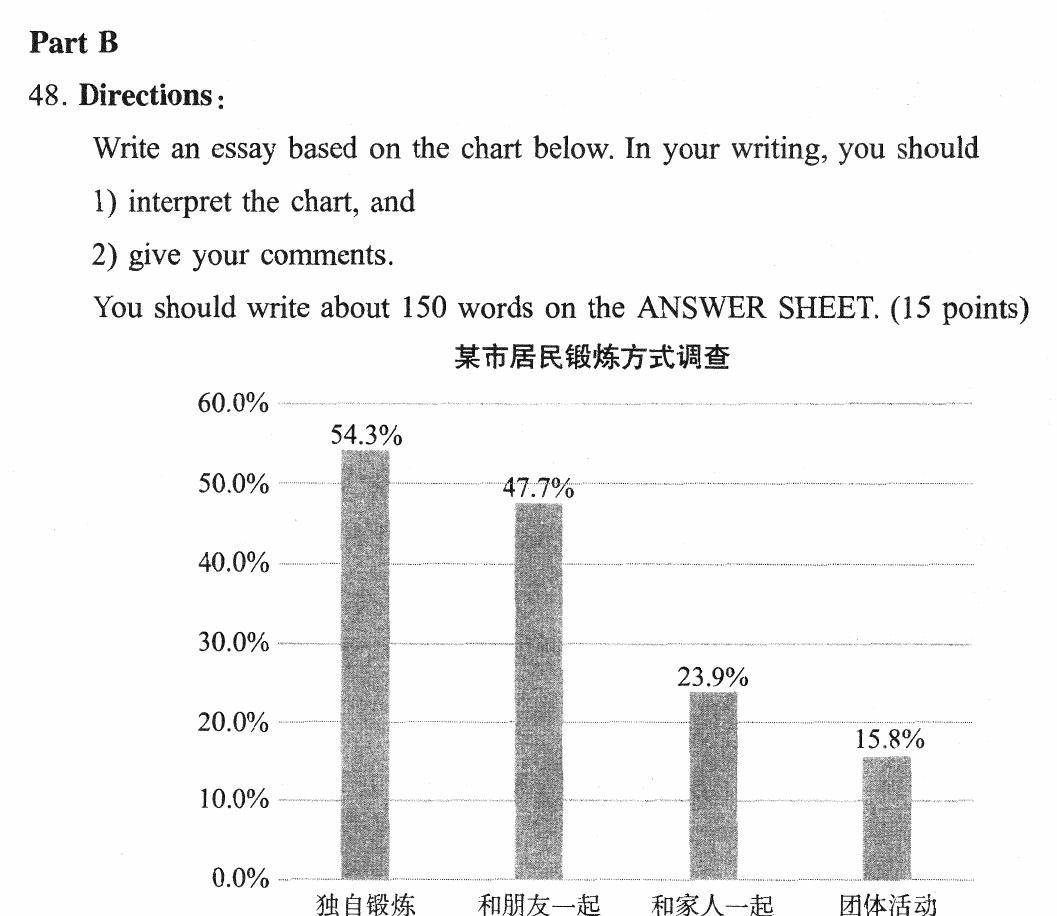
本页为2021年考研英语二真题,支持完形填空、阅读、新题型、翻译和写作在线练习。
写作题目:邀请国际学生Jack参加线上会议并告知细节。
翻译题干节选:SHEET. (15 points) We tend to think that friends and family mermbers are our big…